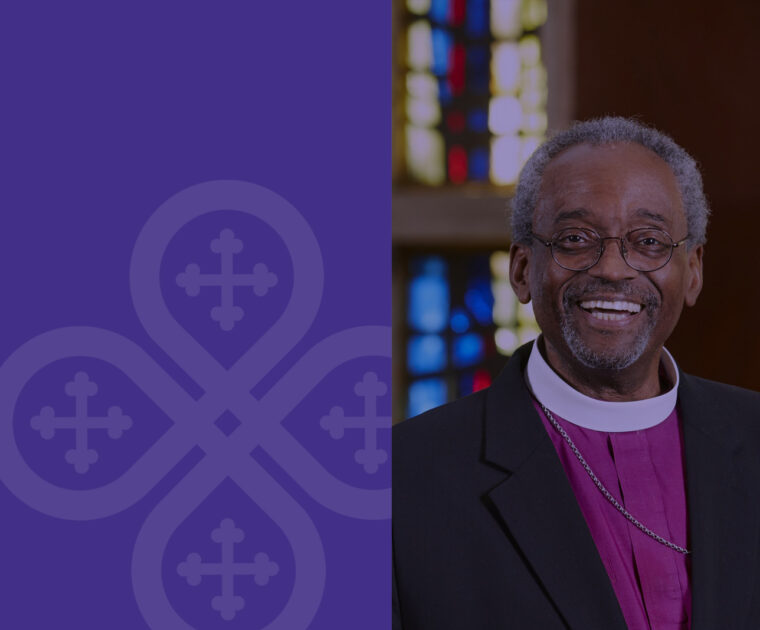
"Since I became bishop in 2000, I have been trying to position the Episcopal Church in this part of North Carolina
as a church whose doors are truly open, and the work of the Pauli Murray Project is a part of that. I am inspired and impressed with the Pauli Murray Project because of the way this project brings together diverse congregation.."
- The Rt. Rev. Michael Curry, Bishop, Diocese of North Carolina
The Consortium, in conjunction with the Duke University Human Rights Center, is honored to present To Buy the Sun, a new play exploring the life and legacy of Pauli Murray. The Pauli Murray Project supports – among other things - efforts to employ history as a tool for engagement with social justice issues. The project has received tremendous support from Rt. Rev. Michael Curry, Bishop of the Episcopal Diocese of the North Carolina.
The Reverend Dr. Pauli Murray (1910 – 1985) was an American civil rights advocate, women's rights activist and feminist, lawyer, writer, poet, teacher, and ordained Episcopal priest. Raised in the segregated South, she learned to live as a multiracial woman, for she was black, white, and Cherokee Indian.
15 years before Rosa Parks refused to stand, Pauli Murray refused to sit in the back of the bus. 20 years before the Greensboro sit-ins, she organized restaurant sit-downs in the nation's capital. Pauli Murray not only lived on the edge of history, she seemingly "pulled it along with her." 123 years after her enslaved grandmother was baptized at Chapel of the Cross in Chapel Hill, NC, Pauli Murray returned to Chapel of the Cross as America's first female African-American Episcopal priest to celebrate her ground-breaking Eucharist. A lifelong champion for human rights, Pauli Murray's struggles and insights resonate powerfully in our times.
Murray received recognition for her service to society before her death in the form of being named "Woman of the Year" by the National Council of Negro Women in 1946; being awarded the Eleanor Roosevelt Award from the Professional Women's Caucus in 1971; andreceiving honorary degrees from Dartmouth, Radcliffe, and Yale, as well as other colleges and universities.
The PAULI MURRAY PROJECT at the Duke Human Rights Center focuses on lifting up the life and legacy of human rights activist Pauli Murray; promoting open community dialogue about the pressing issues of our times; documenting hidden histories of social justice activism; and renovating Pauli Murray childhood home in Durham, NC as a center for dialogue, education and mobilization for equality and justice. For more information: www.paulimurrayproject.org